|
| |
|
| |
|
|
|
|
|
|
| |
|
| |
|
| About kidney stones |
|
| |
|
You normally have two kidneys which clean your blood, and filter out water and waste products to make urine. |
| |
Small, solid crystals can form from the salts or minerals found in your urine. These crystals are often too small to notice, and pass harmlessly out of your body. However, they can build up inside your kidney to form a kidney stone. They are usually yellow or brown, and may be smooth or spiked. |
| |
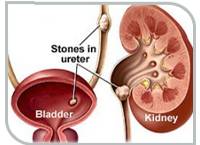
Stones can move out of your kidney into the ureter – the tube that carries urine from the kidney to your bladder. A kidney stone can become stuck in the ureter causing pain, infection and occasionally kidney damage. |
| |
|
|
 |
|
|
| Kidney stones shouldn't be confused with gallstones, which don't affect the kidneys and are caused by raised cholesterol levels. |
|
| |
|
| Symptoms of kidney stones |
|
| |
|
Many kidney stones are too small to cause symptoms. But if a kidney stone causes a blockage, or moves into your ureter, you may: |
|
| |
|
|
|
You can also have these symptoms if you have a urinary tract infection (UTI) or cystitis. If you have one or more of these symptoms, you should ask your GP for advice. |
|
| |
|
The pain of kidney stones – called renal colic – can be very severe. It begins as soon as the stone becomes stuck in the ureter, and tends to come in waves. It's not usually associated with the size of the kidney stone – sometimes small stones can cause more pain than very large ones. |
|
| |
|
Small kidney stones are usually passed out of the body within a day or so and mostly within six weeks. Bigger stones are less likely to pass out of the body spontaneously. Stones greater than 5mm (a quarter of an inch) in diameter are the least likely to pass without medical help. |
|
| |
|
| If you're pregnant and have any symptoms of kidney stones, see your GP straightaway. |
|
| |
|
|
|
|